
What if I can't understand the teacher's accent?
Ask any counsellor what students want to know before flying to Clark and this comes up almost every time: will I be able to understand a Filipino teacher's accent? Hsin-Hsiang Lee, a Taiwanese student who started in September, wrote the answer herself in week two.
Yes, you need some time to adjust
"When classes first started, I did need some time to get used to the teachers' accents. But I think if you just listen a lot and practise speaking a lot, you get used to it quickly — so there's no need to worry too much."
What makes that honest is that she didn't delete the first half. The adjustment is real. She simply wrote down what happens after it.
Your ears go through the same process wherever you land. English in the American South, in Scotland, in rural Australia — none of it sounds like the audio on a textbook CD either. The real difference isn't how long the adjustment takes; it is how many minutes you spend speaking while it happens. In a one-to-one lesson you can say "sorry, again?" on the spot. In a room of twenty, it usually just goes past you.
Lessons start by asking what you came for
"Before the course starts they find out the student's learning goals and the parts they want to strengthen, then build the lesson content around those needs. Every teacher has their own strong area, so you learn a lot from the different classes."
There are two separate things in that.
First, the order is ask, then build. Nobody hands the same syllabus to everyone; they check whether you are here for an exam, for work, or simply to start speaking, and then choose the book and the drills.
Second, the teachers are different people. A Hybrid timetable has several one-to-one periods a day and a different teacher in each one. One is good at pronunciation repair, one is good at pulling words out of quiet students, one is strong on business language. From the student's seat, that means several kinds of English in a single day.
Her enrolment is four weeks of TALK4 Hybrid A followed by six weeks of Business — ten weeks in total. She wrote this in week two of the first four.

The day she landed
Clark International is small: about five minutes from the arrivals hall to the van. People underestimate that. Fly into Manila instead and you still have two to three hours on the road ahead of you, with your luggage and your jet lag, and day one turns into an ordeal.

Where she lives — the new quad room
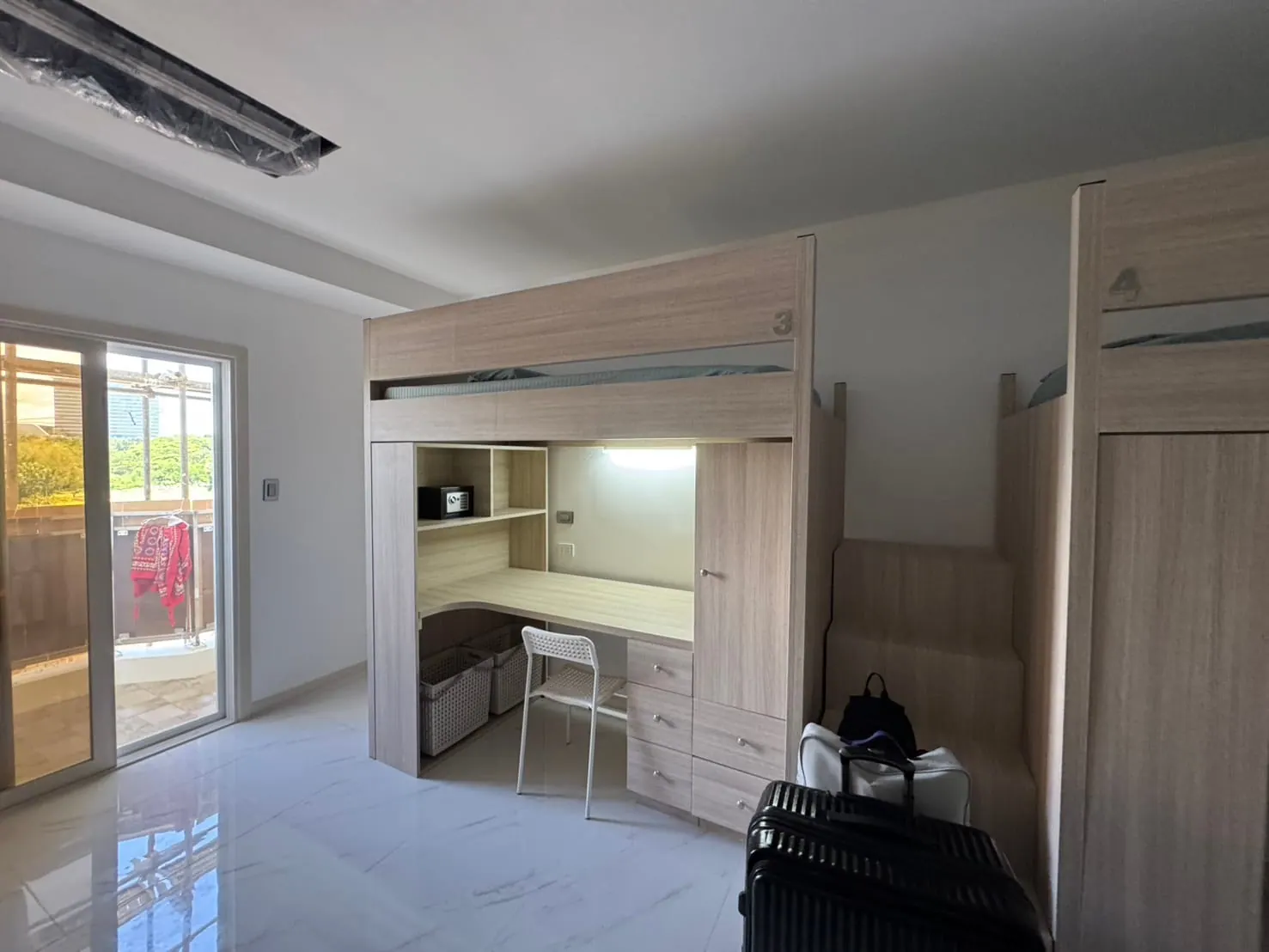
"For accommodation, I am currently in the newly built four-person dorm. Occasionally there is something that needs adjusting, but the school's admin team helps sort it out quickly."
The useful part of that sentence is "something that needs adjusting." A newly finished building always has things to fix; claiming otherwise would be the strange answer. The question worth asking is not whether problems come up — it is how fast they get handled once you say something. Her word for it was "quickly."
Each place in the quad room is one loft unit: bed on top, desk, wardrobe, drawers and a safe underneath, so everyone gets a small private zone. The room opens onto a balcony.
The hours where English stops being a subject
"I have also got to know a lot of classmates from different countries, and through talking with them I practise English and learn about different cultures."
The school has students from Vietnam, Korea, Japan, Saudi Arabia, Mongolia and Taiwan at the same time. None of them speak Mandarin, so arranging dinner, asking directions and complaining about a long day all have to happen in English. It is not on the timetable, and it is the longest block of the day.

Two weeks in
"After two weeks of study, I feel my speaking is more fluent than when I arrived, and I have more confidence opening my mouth in English."
Two weeks is short. That is exactly why the sentence is useful: it is not a graduate's retrospective, it is a progress report from someone still in the middle of it.
If the accent is what is worrying you
It generally stops being the issue after about two weeks. What to prepare before you fly is not pronunciation — it is something to say: what you do, what you studied, what you do at weekends. The teacher will ask, and you will want an answer ready.
Want to know about the courses?
Enrolment, start dates and quotations for Talk Academy are handled by partner agencies in each country. Tell them your level honestly, and how many weeks you can take.