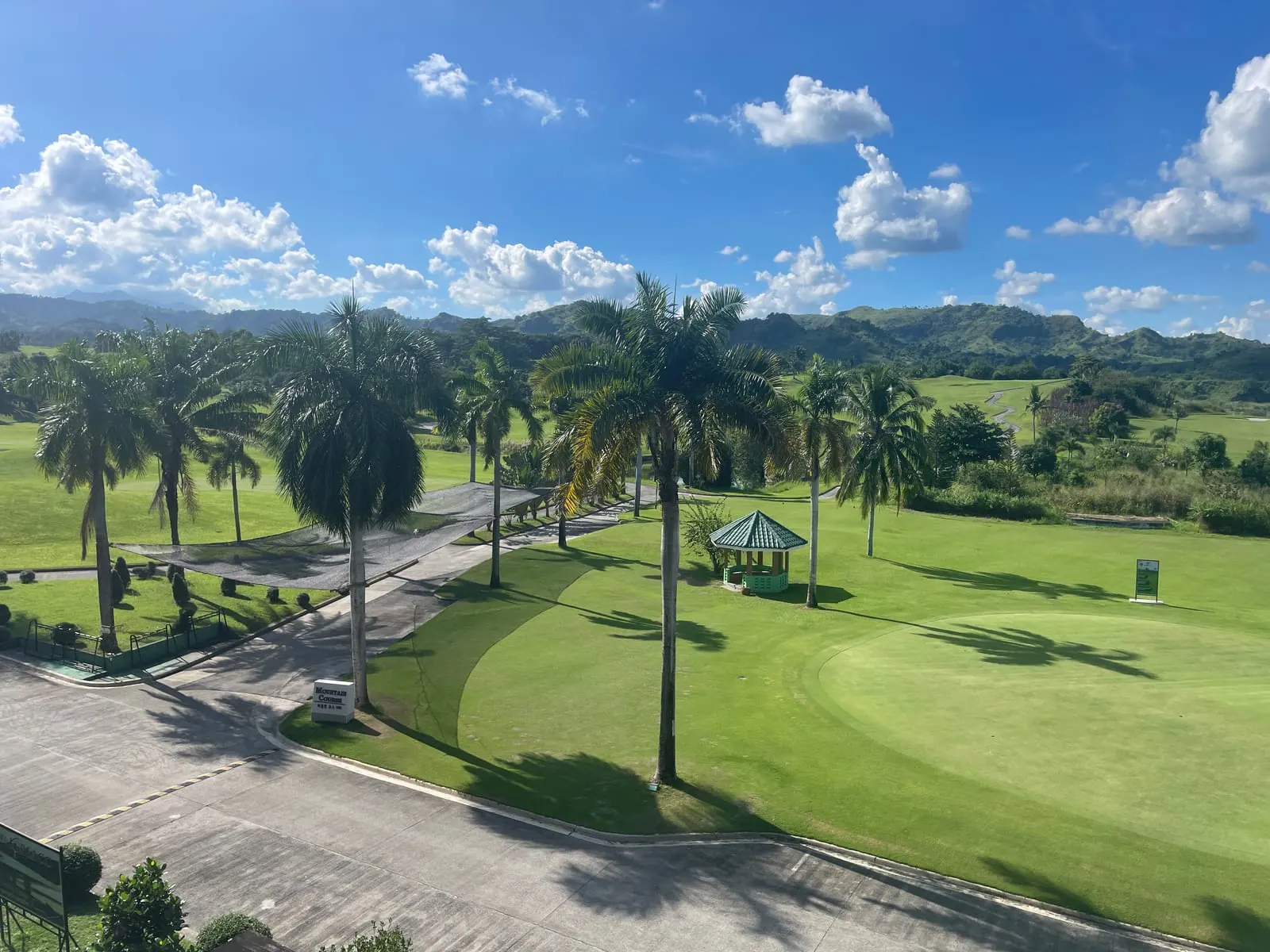
Golf and English in One Course: How the Day Works
"Study English in the morning, play golf in the afternoon" reads like a holiday with a certificate attached. It is also an honest reason adults choose the Philippines over Canada or Australia: course access is affordable, the season never closes, and the courses sit a short drive from the school.
The catch is arithmetic. A round eats half a day, and the timetable wants that same half. Whether the plan works is decided by the schedule you agree to before you fly, not by how motivated you feel in week one.
What the day actually looks like
| Part of the day | What happens | What tends to go wrong |
|---|---|---|
| Early morning | Practice or an early tee time — in this climate, the only comfortable slot | Early tees need early nights, so evenings stop being study time |
| Late morning to afternoon | One-to-one and small-group classes, back to back | Concentration after hours of walking in the heat is not what you paid for |
| Evening | Review, homework, preparing for tomorrow | The block that disappears first, and quietly |
Notice that this is the brochure's day in reverse: the heat sets the tee times, not the marketing copy. Any sample timetable is an illustration rather than a promise, and two questions settle most of it — does golf replace class hours or sit beside them, and how many hours are left once it does. TALK runs 13 programs for the English and Chinese markets, and they do not all carry the same load, so ask which one the golf option attaches to. What those hours feel like is covered in what happens inside a 1:1 lesson.
The comparison you are really making
Most readers are weighing the Philippines against an English-speaking country, and the structure matters more than the price. One-to-one hours are standard here and an expensive extra elsewhere, which is why speaking often moves faster in a short stay. Your teachers are Filipino, university-educated and working in English all day. TALK does have a native-speaker teacher on staff, but he trains the Filipino teachers and does not take student classes. If being taught by a native speaker is your reason for going abroad, this is the wrong country, and no golf package changes that.
Clark has its own international airport, and Manila is roughly two hours away by road. Most students arrive on a tourist stamp rather than a student visa arranged months in advance, though visa-free rules differ by nationality — check the official list for your passport. The study paperwork is handled locally instead, after you land. A fuller side-by-side sits in our Clark versus Australia comparison.
What golf actually does for your English
Three things work. Course vocabulary is narrow and repeats, which suits lower-intermediate learners. You have real reasons to speak, rather than a topic invented for the hour. And hours spent walking together lower the barrier in a way a classroom rarely does.
Three things do not, and they are why the plan fails when it fails:
- A round is not a lesson. Four hours on a course can produce very little English. As study time, that is a poor exchange rate.
- Golf groups drift into a shared first language. Comfortable, and close to zero English all morning.
- Missed classes compound. One skipped day makes the next week heavier, and the week after heavier again.
The fix is unglamorous: decide your rounds per week before you arrive, and write the number down. Left open, it goes up.
| Your situation | Verdict | Why |
|---|---|---|
| On sabbatical or between jobs | Good fit | Recovery and study can share a week |
| Retired, staying several months | Good fit | You can pace both without losing either |
| Deadline for a test or interview | Think hard | Golf takes class hours you cannot get back |
| New to golf | With conditions | Practice often, play rounds rarely at first |
| Funded by an employer | Check first | Some sponsors will not pay for time on a golf course |
The money and paperwork the brochure leaves out
Golf sits on top of tuition: green fees, caddie fees (caddies are standard at Philippine courses, not an optional extra), cart hire, club rental or airline baggage, and transport. All of it varies by course and season, so ask for a written quote with each of those as a separate line. TALK enrolls through partner agencies rather than selling directly, so the quote comes from the agency — and anyone offering a confident figure from a blog post, this one included, is guessing.
Government fees are separate again, and easy to underestimate if golf tempts you into a longer stay.
| Item | Fee | When it applies |
|---|---|---|
| SSP (Special Study Permit) | ₱7,800 per application | Everyone enrolling. Note *per application*: some immigration offices issue it only for the length of the course you registered for, so extending can mean paying again |
| ACR I-Card | ₱4,500 | Stays longer than 59 days |
| Visa extension | ₱3,000–6,000 per extension | Every time you stay past your arrival stamp |
A three-month stay therefore carries several extensions and possibly a second SSP. Details are in our guide to the SSP, ACR I-Card and visa extensions.
Common questions
Do I need to be able to play already?
No. But keep rounds few and practice frequent at first: a beginner's round runs long and eats more of the day than the brochure suggests.
My English is basic. Will I cope on the course?
Usually, because course language is narrow and repetitive. Ask your teacher to drill those phrases in class first.
Does golf count as English practice?
Only if you make it count. Play with people who do not share your first language, or accept the morning as recreation rather than study.
How much does the golf option cost?
It depends on the program, the number of rounds and the season, so no honest figure exists in advance. Get it in writing before paying a deposit.
In short
This is a scheduling problem wearing a lifestyle brochure. It suits people with time and no deadline, who cap their rounds and protect their class hours. Before committing, get two things in writing: how many class hours the golf program leaves you, and every cost it adds above tuition. Then add the permit fees, because those arrive whether you play or not.