How English Pronunciation Correction Actually Works
Most people who look this up expect the answer to be "learn to sound like a native speaker." That is not what a pronunciation class does, and for international learners it is not even a useful goal. The working target is narrower: stop being asked to repeat yourself.
That matters if you use English the way most of the world does — with people who also learned it as a second language. Your listener is more likely to be Indonesian, German or Brazilian than American. Nobody in that room has a native accent, and nobody needs one.
What correction is actually aiming at
A teacher does not rebuild your accent. They look for the few sounds that stop you being understood, and work only on those. In most adults that list runs to three or four items rather than twenty, which is why change is measurable in weeks rather than years.
The limit is worth knowing before you pay. If people ask you to repeat because you speak too fast, run out of vocabulary mid-sentence, or drop your volume when unsure, drilling sounds will not fix it. An honest teacher says so in the first week.
How a correction cycle runs
The sequence is much the same everywhere. What differs is how far a school takes it.
| Stage | What happens | Where it fails |
|---|---|---|
| 1. Diagnose | Which words made listeners ask again, and the pattern behind them | Wanting the whole accent fixed, so nothing narrows down |
| 2. Isolate | You are told what to change physically: tongue further forward, lips rounder, airflow stopped | Copying by ear alone — you cannot hear your own mouth |
| 3. Word drill | Single words and minimal pairs until the position is reliable | It feels easy here, which is misleading |
| 4. Sentence | The same sound inside a full sentence | It collapses back to the old habit |
| 5. Conversation | The sound survives while you think about meaning | Many courses stop at stage 3 and call it finished |
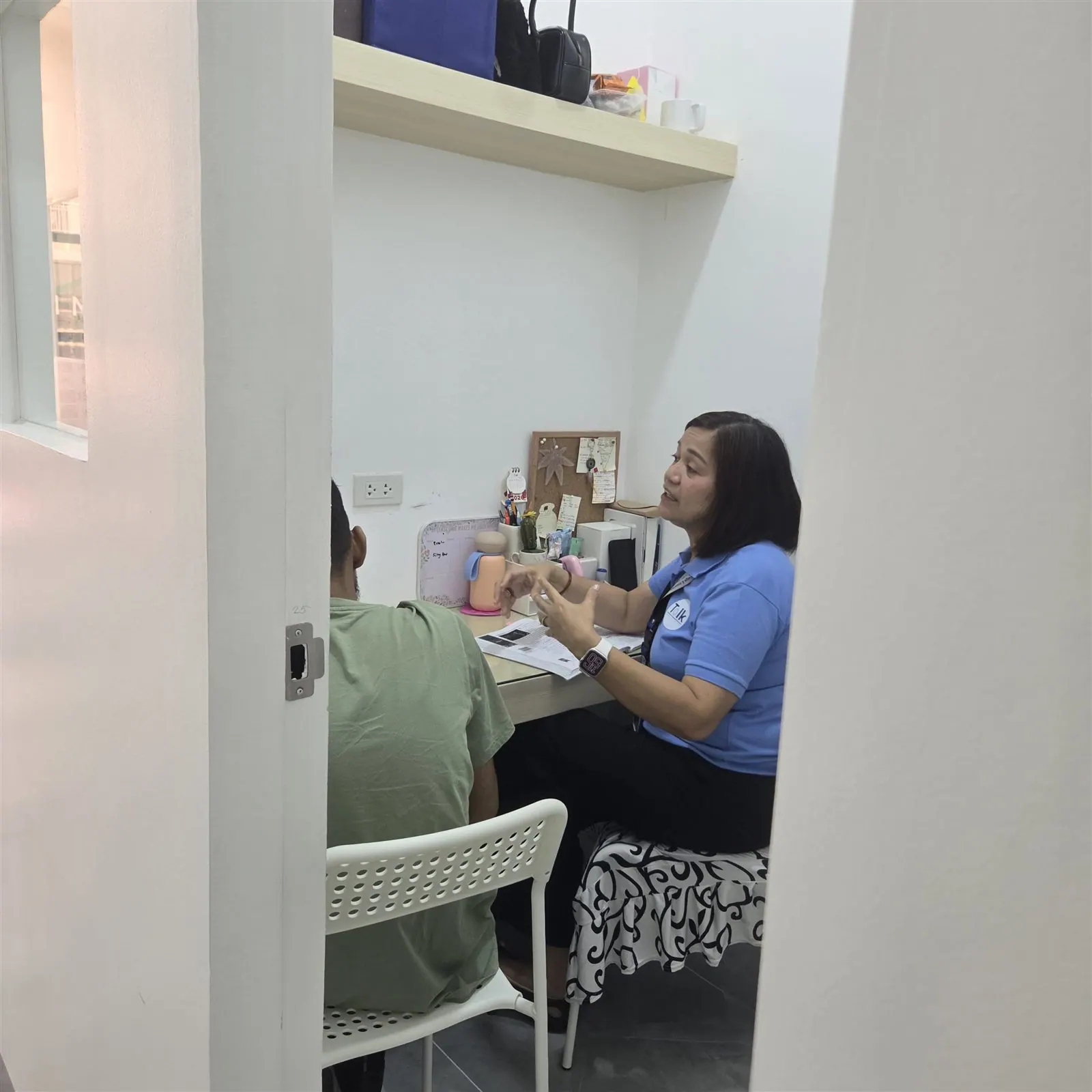
Stage four is the real work. A clean sound in isolation proves little: inside a sentence your attention is on meaning, and your mouth defaults to what it has done for twenty years. It is also why this belongs inside one-to-one slots rather than being sold as a course of its own — someone has to watch one mouth continuously, which is not possible in a group class. See what actually happens in a 1:1 booth.
Where different first languages get stuck
These are tendencies, not rules about people. An accent by itself is not an error; only the parts that block understanding get touched.
| First language | What often appears | What the drill targets |
|---|---|---|
| Mandarin, Cantonese | Final consonants softened or dropped | Releasing the end of the word |
| Japanese, Korean | An extra vowel added after a final consonant | Stopping the sound cleanly |
| Vietnamese, Thai | Consonant clusters simplified | Holding the whole cluster |
| Arabic, Farsi | A vowel slipped inside a cluster; in Arabic, p and b merge | The cluster kept whole, then minimal pairs one contrast at a time |
| Spanish, Portuguese | An extra e- before words beginning with s + consonant | Starting the word on the s |
| Hindi, Tamil, French | Stress spread evenly, or landing on the last syllable | Sentence rhythm rather than single sounds |
In practice, stress and rhythm cause more repeat-requests than individual consonants do. An imperfect consonant in a correctly stressed word is usually understood; a perfect consonant in a wrongly stressed word often is not.
The parts people find out later
No native speaker will correct you. TALK has a native-speaker teacher on staff, but he does not take student classes at all — he trains the Filipino teachers, and every class a student sits in, one-to-one and group alike, is taught by a Filipino teacher. That is less of a compromise than it sounds: correction is a matter of describing a difference precisely and then drilling it, which trained teachers do well. Even so, if an agency suggests you will be sitting across from an American or a Briton, ask which school and which teacher before you pay anything.
It is repetitive. Saying the same handful of words dozens of times over is not interesting, and students who want every hour to feel like a conversation quietly drop this work.
Exposure outside class is limited. You hear English in class and in part of daily life, but not in the unavoidable way you would in Dublin or Toronto. What you buy in Clark is a high number of one-to-one hours; what you give up is immersion, a trade-off set out in our Clark versus Canada comparison.
Government fees sit on top of tuition.
| Item | Amount | When it applies |
|---|---|---|
| SSP (Special Study Permit) | ₱7,800 per application | Required in order to study. Not a one-time fee — some immigration offices issue it only for the length of the course you registered for, so extending can mean paying again |
| ACR I-Card | ₱4,500 | Stays longer than 59 days |
| Visa extension | ₱3,000–6,000 each | Every extension beyond your permitted stay |
Many passports get only a short visa-free entry on arrival, so a course of any real length runs on extensions from the start. Check the rule for your own nationality rather than a friend's — how the SSP, ACR I-Card and extensions work sets out the order they arrive in.
Do not take any tuition, flight or living-cost figure from a blog post, this one included: they move with the season, the room type and the timetable. TALK enrolls through partner study-abroad agencies rather than selling directly, and runs 13 programs across its English and Chinese markets, so ask your agency for a written quote naming your program and the one-to-one hours it contains.
Frequently asked questions
How long before I hear a difference?
For the two or three sounds that block understanding, several weeks of daily one-to-one work is usually enough for the repeat-requests to drop noticeably. Changing a whole accent is a different project.
Can I do this without a teacher?
Partly. Recording thirty seconds of yourself each day shows the gap between what you think you said and what you actually said. Diagnosing the cause is the part you cannot do alone.
Is it worth flying here only for pronunciation?
Probably not on its own. It makes sense as one part of a course that also covers speaking, listening and confidence. If sound is genuinely your only weak point, online sessions from home may be the more sensible purchase.
In short
Correction is a sequence, not a talent: find the few sounds that break understanding, change where they are made in the mouth, then carry them through sentences until they survive real conversation. Stage four is where it usually fails. The honest limits are that it is repetitive, that it will not repair vocabulary or confidence, and that government fees run on top of whatever your agency quotes.